
AT&T Ad Campaign
AT&T AD Campaign Connecting changes every(little)thing. AT&T has been a pioneer in telecommunications. However, in today’s times, they have lagged behind the industry’s lead competitors, T-Mobile and Verizon. So, for the 2025 National Student Advertising Competition, the AAF asked 92 teams to help make Gen Z crave AT&T as a brand and service provider, and celebrate its commitment to supporting businesses, first responders, and local communities. For JWU ADTEAM, the answer was simple: create a campaign strategy highlighting Gen Z‘s love for empathy and authenticity. We focused on more humorous and informative advertising across digital and out-of-home media, bridging the digital divide between traditional and mainstream marketing. The Journey We took their slogan — “Connecting changes everything” — and elevated it to highlight the small, everyday moments. Connecting doesn’t just change everything. It changes every(little)thing, which became the heart of our campaign. From a conversation with your grandmother that changes gears to a bus shelter that tells you when your next bus arrives, we spared no expense in heralding the average person living the day-to-day. The Protagonist As a member of the creative team, I was tasked with bringing the team’s research and strategy to life. We asked ourselves: “How does connecting change everything?” From there, we took AT&T’s slogan and made it a fill-in-the-blank. “Connecting Changes…” became a pedestal for big ideas about small changes. After hundreds of possible scenarios and solutions, we came up with six ad spots, three OOH activations, and one anthem spot that best applied and represented our team’s campaign. I was responsible for three of the ad spots — “Gears,” “Moves,” and “The Game” — which sought to explain what people love about small moments. This was also a way to connect AT&T to its digital footprint and how telecommunications factors into their slogan. However, our team’s work would not have the same staying power if not for my help in delivering our campaign’s plans book cover, anthem spot, and client presentation. From the start, I knew the anthem had to encapsulate everything the team had been working on since the fall semester. From there, I wanted to tell a story. Life’s smaller moments are often what lift us at our lowest points, and our campaign could deliver that message through a lens of compassion and empathy. I approached the spot with this in mind, and stitched together something that not only tells our team’s story, but teaches us what the small moments are all about. With my eye for storytelling, I soon became a candidate to present our campaign to judges. It was not an easy task, as performative skills often rely on one’s confidence in the material, but I knew the message our team wanted to send to the judges and AT&T. So, alongside three other presenters, I got to work on drafting, revising, and rehearsing our presentation. Our performance aligned with our campaign—simple, authentic, and engaging. The Lesson Our campaign’s plans book, advertisements, and presentation impressed competition judges from across the industry. A win at districts led to a third in semifinals and a fifth at nationals, with every member of the team learning from and reflecting on a job well done. A little team from Providence, Rhode Island, went on to accomplish something big. It empowered us, challenged us, and helped us define our strengths as strategists, media planners, copywriters, presenters, and creatives. For me, working on JWU’s ADTEAM as a designer was one of the most fulfilling experiences I have had as a creative. It demonstrated how far I can take an idea and how well I can understand it. Connecting with the team and the NSAC didn’t just change everything. It’s made me more confident in who I am and what I can do in the future. https://youtu.be/eWyQPmwC6RIhttps://youtu.be/zDnNteBH3hUhttps://youtu.be/Iju5v7tkWiwhttps://youtu.be/g0CnVPukRUI Previous
The District
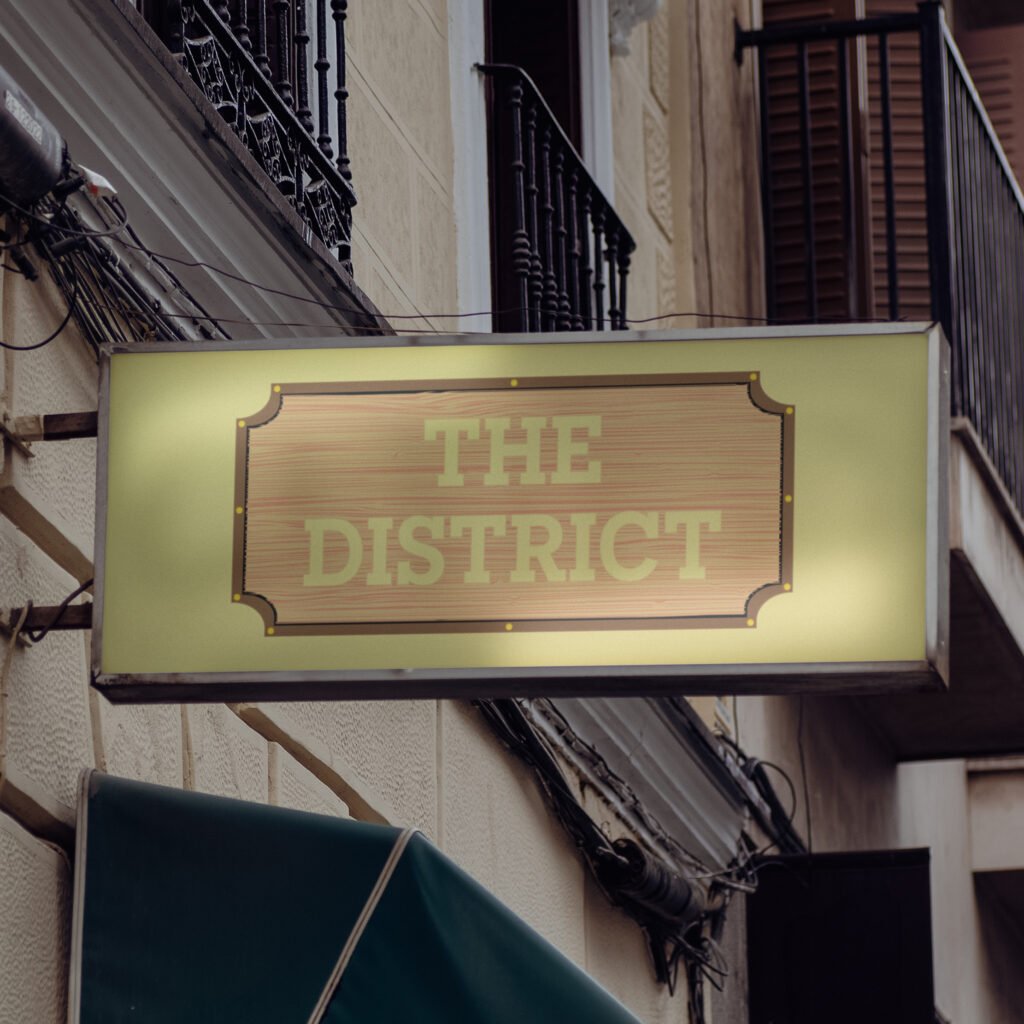
The District Go ahead. Indulge those taste buds. The District is a Providence-based restaurant featuring a diverse menu and an 800° custom brick wood-fired oven. They offer quality food to an array of palates but lack a consistent brand identity displaying their brick oven and rustic, laid-back interior. I was asked to provide the restaurant with a new, fictitious brand identity that highlights its service and offerings. With the rebrand, I called back to The District’s wood-fire oven, which worked in tandem with the restaurant’s rustic interior. Their new logo and menu bridge the gap between its pizza oven and supporting brand elements, providing a consistent, sleek, and rustic aesthetic that people would appreciate. The Journey The District’s new identity establishes a distinct voice compared to that expected of casual dining or pizza restaurants. Their current feel influenced their new identity, providing consistency across all platforms. It informs new customers about the quality service the restaurant offers and returning customers about what they know and love about The District’s food and rustic atmosphere. The new branding’s wider, more accessible visibility provides an opportunity to grow and expand a new customer base hooked by its new, relatable copywriting. Its menu provides customers with a tangible, textured feel, etched into the very planks of wood used in their brick oven. Advertisements use imagery of their delectable menu to make even the casuals crave their specialty pizza, with a concise yet relatable tone of voice that entices onlookers to see what the restaurant has in store for them. The Protagonist I did my due diligence to look through The District’s current brand identity and voice to understand what they and their customers love about the restaurant and what they could do to bring in a new mass of customers. Their casual interior and quality food were not well-supported by their current branding, menu, or building exterior. I asked myself: Why not go all-in on the rustic and wood-fired experience? Thus, I set out to explore brands that have done similar executions and decided to make the rebrand with tangible and relatable. Both elements were already present while dining with the restaurant, so why not also provide a consistent tone of voice to the brand’s identity? I used their interior as the starting point and gradually inserted the wooden, rustic appearance many would appreciate about the restaurant and its pizza oven. Once I landed on a design that felt equally sleek and modern to match their current branding, I adjusted the color palette to maximize contrast and legibility. My approach to the logo’s redesign soon fed into their menu, which would be displayed on wood planks and given a smooth yet textured feel for customers to use and look through. The menu, organized by section, is not overwhelming on the eyes and utilizes a more casual, bubbly typeface and features a dedicated rounded-edge two-page fold for their pizza selections. Lastly, the restaurant’s advertising incorporates their new logo, typography, and tone of voice with their current mouth-watering imagery for customers to relate to and gravitate towards whenever they walk by the spot or see an ad out in the wild. The Lesson The District’s new brand identity doubles down on what people love most about the restaurant: its wood-fired pizza and casual dining experience. Their current feel influenced their new identity, providing consistency across all platforms. It informs new customers about the quality service the restaurant offers and returning customers about what they know and love about The District’s food and rustic atmosphere. The new branding also provides the restaurant wider and more accessible visibility, providing their online presence the opportunity to grow and expand with a new customer base that is hooked by their new, relatable copywriting. The rebrand flexed my creative muscles and helped explore an avenue already present from The District that deserved to be showcased to anyone interested in trying out their food fare. I wanted myself and others to feel good about The District before, during, and after their time with them, because there is no better feeling after a long day of work, school, or travel. The rebrand, plus its logo, menu, typography, and advertising, are a testament to how far the restaurant can go with rustic wood-fired pizza as their specialty. PreviousNext
Type Posters
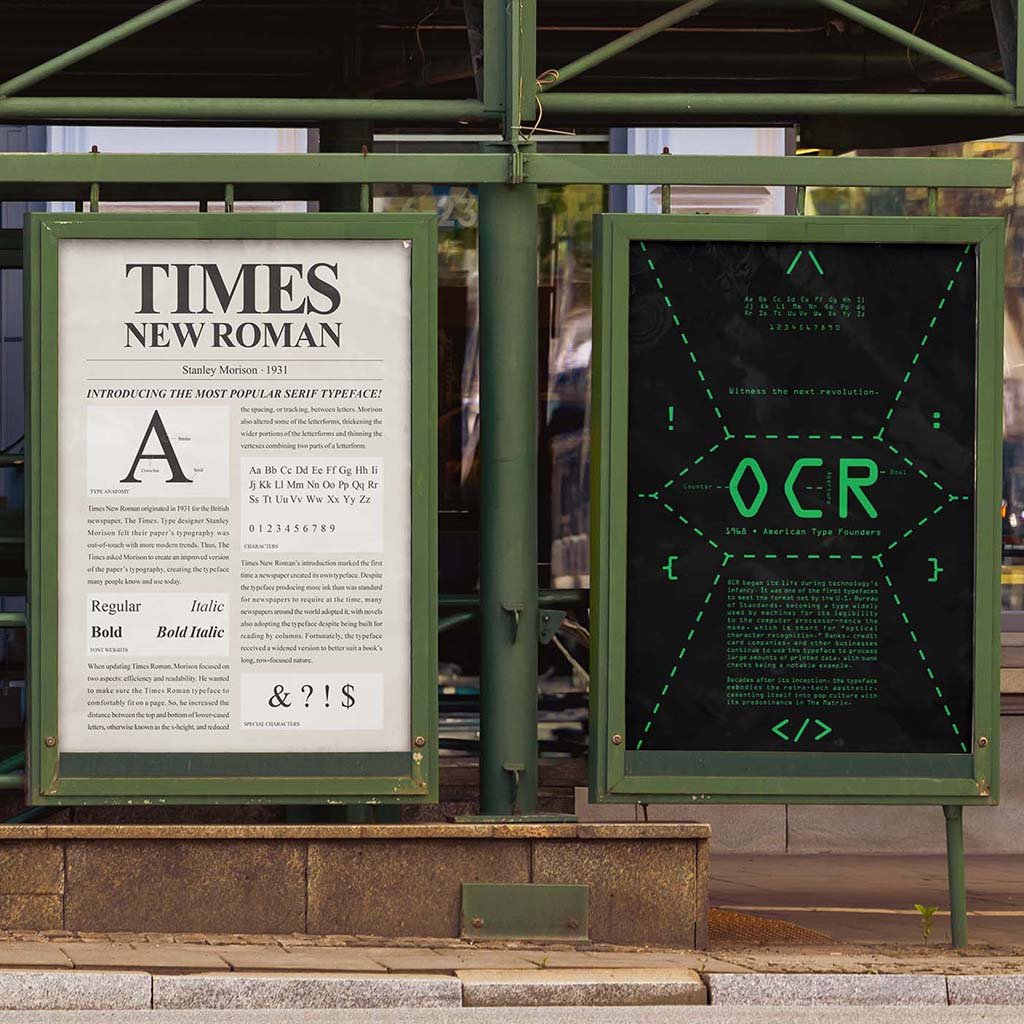
Type Posters Paying Homage to Font History Creating font posters allows for newfound knowledge of type history, including a better understanding of type classifications and anatomic identifiers unique to that font. Establishing a visual and typographic hierarchy throughout the design process is paramount to a successful and refined layout, with sketches being the first step in the design process. Tasked with this, I created posters for three of the world’s best-known fonts, each a different typeface. Goals and Process I picked three fonts—Nobel, Times New Roman, and OCR—and conducted research on how they came to be and what people have been using them for. I sketched out designs representing each font’s history and use cases. I wanted each poster to tell their respective font’s story and cultural significance, conversely creating attention-grabbing compositions that people would be interested in learning about them. Once in Illustrator, I refined each poster’s composition and layout. Originally, for Nobel, I combined the color scheme of one design with an abstract letterform. However, I later reverted back to the original design and added particular elements that were missing previously, with the intention of better implementing the font and its history through the poster’s layout of information and text hierarchy. With OCR and Times New Roman, it was moreso a matter of refining what was present, so they worked best in the confines of the poster—changing font sizes, location, and colors when seen fit. The Results For Times New Roman, the aesthetic emulates how the font was popularized through books and newspapers. The poster takes minimal knowledge to determine how to read it, emulating what it’s like to read a page from a newspaper that many will be accustomed to. Therefore, elements like headings, the typeface’s creator, its date of creation, and its type anatomy replace elements of similar placement (headings, images, captions, etc). The resulting poster’s layout is legible and accessible, making the font choice a perfect embodiment of serif typefaces and their real-world application. For Nobel, I took its sans serif and geometric nature and applied it to a gridded poster focused on type hierarchy. I used a warm and tranquil color palette that pops off the page and allures the eyes to particular elements, such as the font’s name and special characters. The supporting elements fit comfortably in the poster’s confined grid layout, providing a quick distinction between each aspect of the font. The type’s anatomy is also featured after determining how to apply those elements without becoming too much of a distraction. Thus, the final design is angular, readable, and colorful—perfectly encapsulating what Nobel is and could be used for. For OCR, I called back to its roots as a coding typeface that embodies the beginning stages of digital technology. With its prevalence in pop culture, thanks to The Matrix, I also wanted to pay homage to what has made the font so popular since the turn of the century. As a result, the poster looks sleek and inorganic, while its composition remains legible. The special characters spread around the poster are those first used in computer code, amplifying the design’s homage to its early adoption by programmers and tech companies. Each poster looks sleek and in line with their historical significance and how many continue to use them in modern design. Most of all, each poster tells a story about its respective fonts and instills their significance in a single image. Next
Racing Type Cards
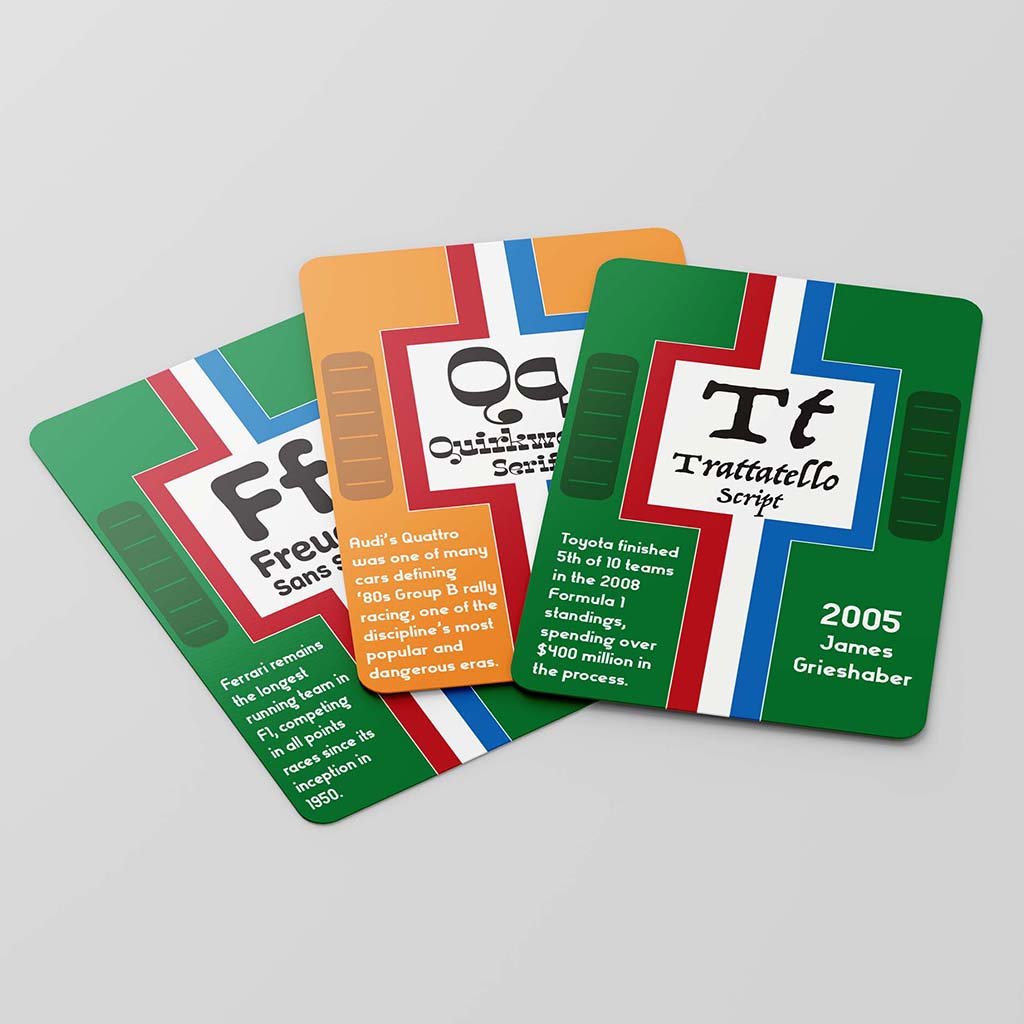
Racing Type Cards Vintage Racing Meets Decorative Typefaces Originally conceptualized as a brand showcasing my skills and expertise in critiquing and analyzing movies, TV shows, and video games, I created a comprehensive brand system with multiple executions across print and digital media, using color theory and typography to represent the brand’s playful and carefree writing style and aesthetic, and create reviews and articles consumers would want to read and enjoy. Goals and Process The card deck became my first crack at applying my passions and interests into a design, hence why the cards feature a vintage racing aesthetic. It required constant attention-to-detail, making sure each card shared the same pattern but told a different story through their fonts. However, it wasn’t until I sketched out several ideas I had for the deck that I came across such an idea for a complete aesthetic. Additionally, the design process proved iteratively challenging, as I had to change text sizes, bleed, and margins to make sure the cards were legible at a small scale and produce a deck people would be interested in reading through and exploring rather than play with. The Results In the end, the cards became an experiential fusion of vintage racing and a typical card deck. Racing has been a lifelong interest of mine, and to have the chance to apply that passion to a design was incredibly fulfilling and helped motivate me to make the deck as great as it could be. The fonts chosen add a little variety into the otherwise monotonous aesthetic the cards and their fun facts deliver, with letter patterns on the back of each card also a cheeky little touch to help the cards feel more practical with the deck’s execution and overall feel. PreviousNext